Shabel Enterprises
Automating Delivery for a Regulated Utility
Major Regulated Utility
Context. A major regulated utility ran its reporting and operations on a large, multi-platform enterprise data estate. The team that maintained it shipped changes by hand, with light governance — slower than it should be, and riskier than a regulated environment can comfortably tolerate. The senior data-architect function was unfilled, so the engagement was really two jobs at once: step into that role and re-engineer how the team shipped work — from hand-checked, hope-it-works releases to automated, auditable delivery the team could trust and run themselves.
The Stakes. For a regulated utility, change control isn't bureaucracy — it is how mistakes are kept out of the systems the public and regulators depend on. Manual, undocumented delivery is both slow and fragile: a single unreviewed change can ripple into the reporting that operations and oversight rely on. Automating delivery with approval, validation, and testing turns "we think it's fine" into "we can prove it" — and does it faster; in a regulated context, that certainty is worth as much as the speed.
The Challenge. Take on an unfilled data-architect role, bring a manual, multi-platform delivery process onto automated, governed CI/CD, harden and standardize the estate, and bring the team along — without dropping quality during the transition.
Our Approach.
- Stepped into the architect seat. Brought deep SQL and BI/DW fundamentals that transferred directly onto the client's enterprise data platform, and took accountable ownership of final code reviews and approvals for every change while the new discipline took root — a deliberate single point of accountability through the transition.
- Ran the full delivery lifecycle on Azure DevOps, end to end. Stood up automated, governed CI/CD across the whole lifecycle — source control, branching, pull requests, approvals, pipelines, work management, and coding standards — with automated static analysis and ticketing built in. Few teams use Azure DevOps across its entire range instead of stitching together a patchwork of point tools; running engineering and delivery management on one platform is what made the whole process consistent and auditable.
- Cleansed and standardized the estate. Ran a comprehensive migration and cleansing of thousands of tables, views, and stored procedures across the estate's multiple database platforms, and standardized import methods — partitioning, logging, structured error handling — for efficiency.
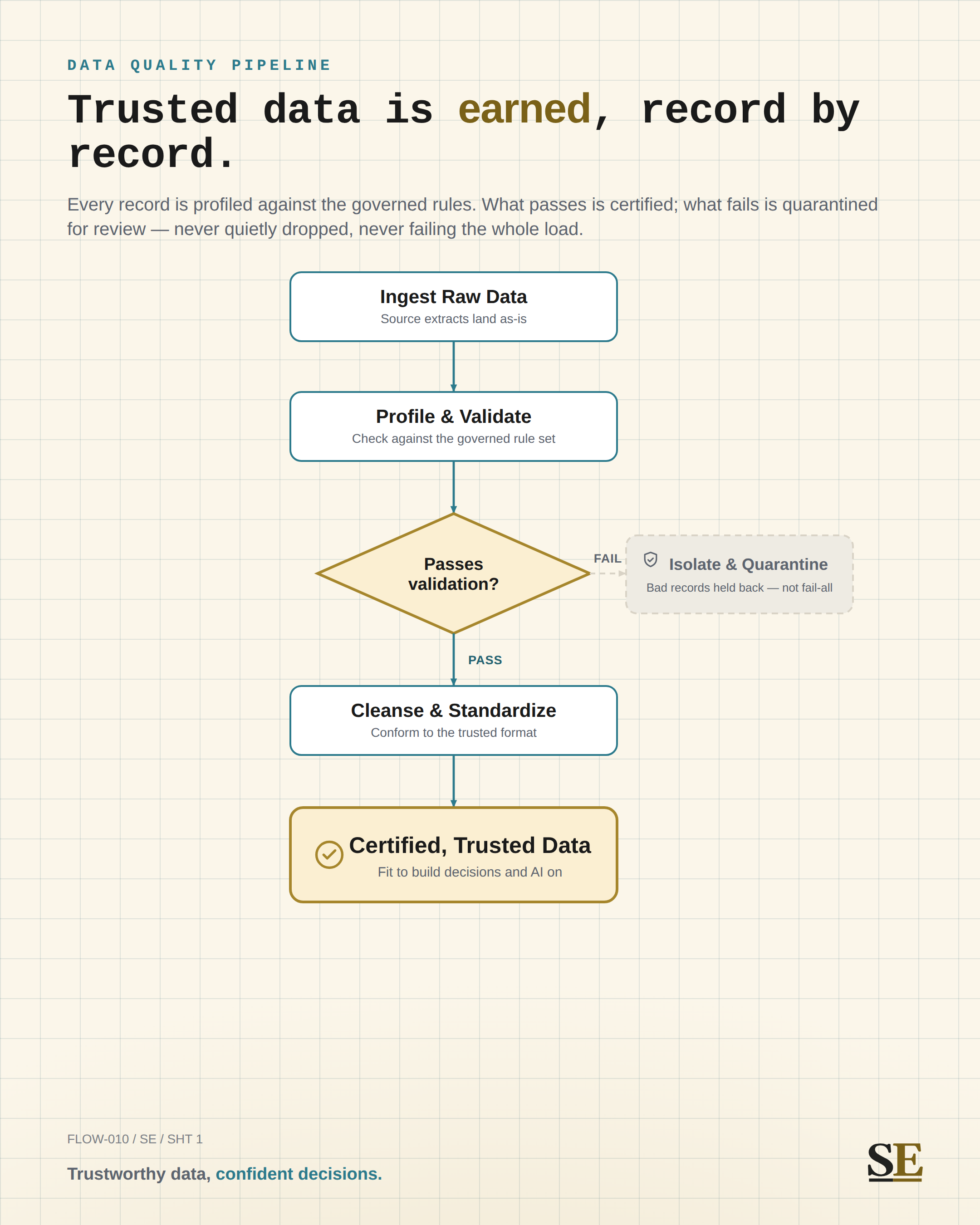
- Engineered for graceful failure. Built robust error handling that isolated bad records and kept pipelines running instead of failing wholesale — turning unreliable data sources and load jobs from middle-of-the-night, all-hands incidents into contained, recoverable events.
- Upskilled the team and planned the work. Trained every member on the delivery pipelines and CI/CD flow, tied story and task management to delivery metrics, and planned with senior leadership on a quarterly cadence. A primary-and-secondary on-call rotation against published SLAs held the off-hours line while the team built its own fluency.
The Outcome. Automated, auditable delivery across a multi-platform enterprise estate; a cleansed, standardized codebase; resilient pipelines that fail safely rather than catastrophically; and a team fluent enough in modern CI/CD delivery to run it independently.
From months to a single sprint. Automated, governed delivery and a scaled-agile operating model turned manual, hope-it-works releases into a predictable cadence — cutting new-data-source onboarding and change lead time from months to a single sprint. Automated static analysis and mandatory review on every pull request drove the change-failure rate to functionally zero, and automated approval, validation, testing, and a full audit trail took change governance from 0 to 100% coverage. Resilient error handling drove production incidents from several in a typical week at the outset to entire quarters without one by the end. And across a multi-platform estate, the engineering team was upskilled to run the whole CI/CD process on its own.
What It Demonstrates. Stepping into an unfilled architect role, holding the quality line through a full delivery transformation, and leaving a regulated team able to ship safely on its own — the disciplined, auditable delivery Shabel Enterprises brings to high-stakes environments.
Capabilities. Delivery transformation · CI/CD automation & governance · end-to-end delivery-platform discipline (full-spectrum Azure DevOps) · code-review governance · enterprise data warehousing (multi-platform) · resilient ETL & error handling · scaled-agile planning · team enablement & upskilling.
← All Case Studies · ← Previous: Mastering Enterprise Data at Global Scale · Next: Standardizing Enterprise Data Integration in Financial Services